Bring the workflow together
Jobs, people, files, and decisions in one place, built around how your business actually runs.
See dispatch and operations →
Custom operations software · Milwaukee
Replace spreadsheets, disconnected apps, and manual handoffs with one system. Work directly with Chris to understand the workflow, build the software, and keep it running.
The buck stops with us.
Custom builds: you own the custom code once build fees are paid in full. Our own products are licensed by subscription.
Where we help
Jobs, people, files, and decisions in one place, built around how your business actually runs.
See dispatch and operations →Replace scattered records and an outgrown app with a system that carries your working history forward.
See an AppSheet migration →Capture photos, scan VINs, and work with records on mobile. Offline workflows where the job needs them.
See field tools →Bring the right information into the workflow through routing tools, customer portals, and data imports.
Talk through your existing tools →Case studies
Two very different operations, built the same way. We don't build demos and disappear: each system below was scoped, built, and supported for a real operation by the same people you'll talk to on the first call.

Case study 01 — Driveaway & decked-truck transport
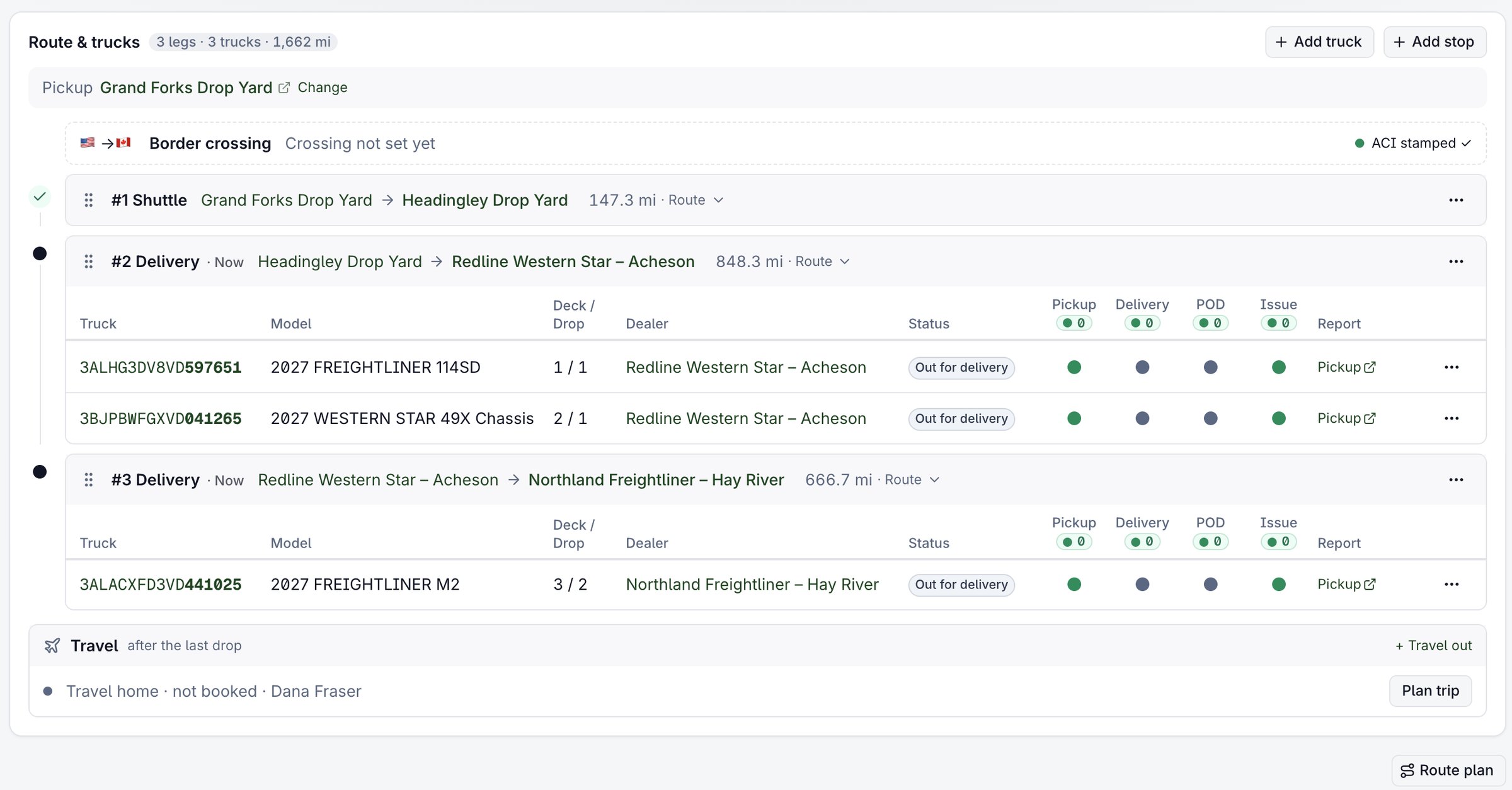
Every load planned — down to the driver's trip home.
Case study 02 — Asset recovery & collections
Built for Mid-Canada Collections
Point a camera at a lot. Every VIN lands on the right file.
How we work
No handoff between sales, build, and support. You work with the people who scope it, from the first call to the system your team uses every day.
We learn how your operation runs, usually over a few calls: who does what, where the work gets stuck, and where it makes or loses money.
You get: A shared picture of the workflow and the problem to solve.
We write one brief describing what we'll build first. You review it and sign it off before we build anything.
You get: A written first-build scope for you to review and approve.
You answer our questions in your own Hub as we go. Nothing is guessed: when we don't know how something should work, we ask.
You get: Working software, with open decisions recorded in your Hub.
We ship it to production. Release notes go in your Hub, so you always know what changed.
You get: A production system and release notes explaining changes.
The same people keep it running and evolve it as your operation changes. Support has a 12-month initial term from go-live, then runs month to month.
You get: Continued support from the people who built the system.
Your customer Hub
Your questions, project documents, requests, and release notes have a home. Spend less time piecing together what happened and more time making the next decision.
Explore an example Hub →A clear next step
The public walkthrough uses fictional content. Customer workspaces require sign-in.
Ownership
On a custom build, the software is yours once the build is paid in full — not rented from us. There's no lock-in: if you ever want to bring it in-house or hand it to another team, it keeps working without us.
The code we write for you is yours when the build is paid in full. The reusable building blocks we bring to it come with a perpetual, royalty-free license, so it keeps running without us.
Your data is yours from day one, and you can export it at any time.
The system can run in your own cloud accounts, or we host it for you. Either way, the code and the data are yours.
Results
Proof, not promises. Every system we've built was scoped, built, and supported by the people you'll talk to, and every capability below ships in at least one of them.
Who runs this
You don't get passed from sales to build to support. The person who scopes the workflow is on the build — and is the one who picks up when something breaks.
Leads every system we take on: on the discovery calls, in the code, and on the phone when something needs fixing.
Our products
Alongside custom builds, we build and run software of our own in industries we know well. Our products are subscriptions: we own and run the product, and your data stays yours.
In production
Dispatch, evidence, and payroll for driveaway and piggyback carriers. In production with Run Rite Freight Systems.
In pilot
A design-to-job platform for trades: visual design sessions with the customer, then the proposal, the agreement, and the job.
In development
A repossession and collections platform for agencies and lenders. The multi-tenant product builds on our experience with Mid-Canada’s dedicated system.
FAQ
Any operations-heavy business that runs on spreadsheets, phone calls, and handoffs between people. Our case studies are in asset recovery and truck transport, but what we look for is the shape of the work, not the industry.
We set up a first call to learn how your operation runs today. If custom software is worth building, we tell you — and if it isn't, we tell you that too. If it is, a few discovery calls lead to one written MVP brief that you review and sign off before we build.
On a custom build, you do. The code we write for you is yours once the build is paid in full, and your data is yours from day one. Our reusable platform and tools stay ours, but you get a perpetual, royalty-free license to the parts built into your system, so it keeps working without us. It can run in your own cloud accounts or we can host it — either way, there's no lock-in. Our own products work differently: they're subscriptions, and we own them.
We discuss pricing on the first call. The scope, integrations, data migration, and support needs shape the proposal. Your Statement of Work sets out the agreed build or setup fees and any ongoing fees, so you can review them before committing. A custom build and a product subscription are different arrangements; we explain which applies.
We have migrated working records from AppSheet into new systems. We review your source data, agree what needs to move, and identify gaps or cleanup before planning the transition. The migration scope belongs in the project agreement; not every record or integration transfers automatically.
Access and data needs are part of planning the system. Our customer Hub requires sign-in and limits customers to their own workspace. For a new build, we discuss roles, hosting, data transfer, and recovery requirements with you. Read about working with your data →
Each engagement has a 12-month initial term from go-live, while the same people keep the system running and evolve it as your operation changes. After that it runs month to month, and either side can end it with 30 days' written notice. Termination for cause is always available.
Through your own Hub. We post our questions there and you answer them as we go, so nothing is guessed. Once you're live, release notes go there too.
Chris leads every engagement. The person who scopes your workflow is on the build and the support — no handoff to a separate team.
Custom builds are our main work. We also run our own products — Deckd, Iron Crew Garage, and RepoSphere — in industries we know well. Those are subscriptions: you use the product while you subscribe, we own it, and your data stays yours.